
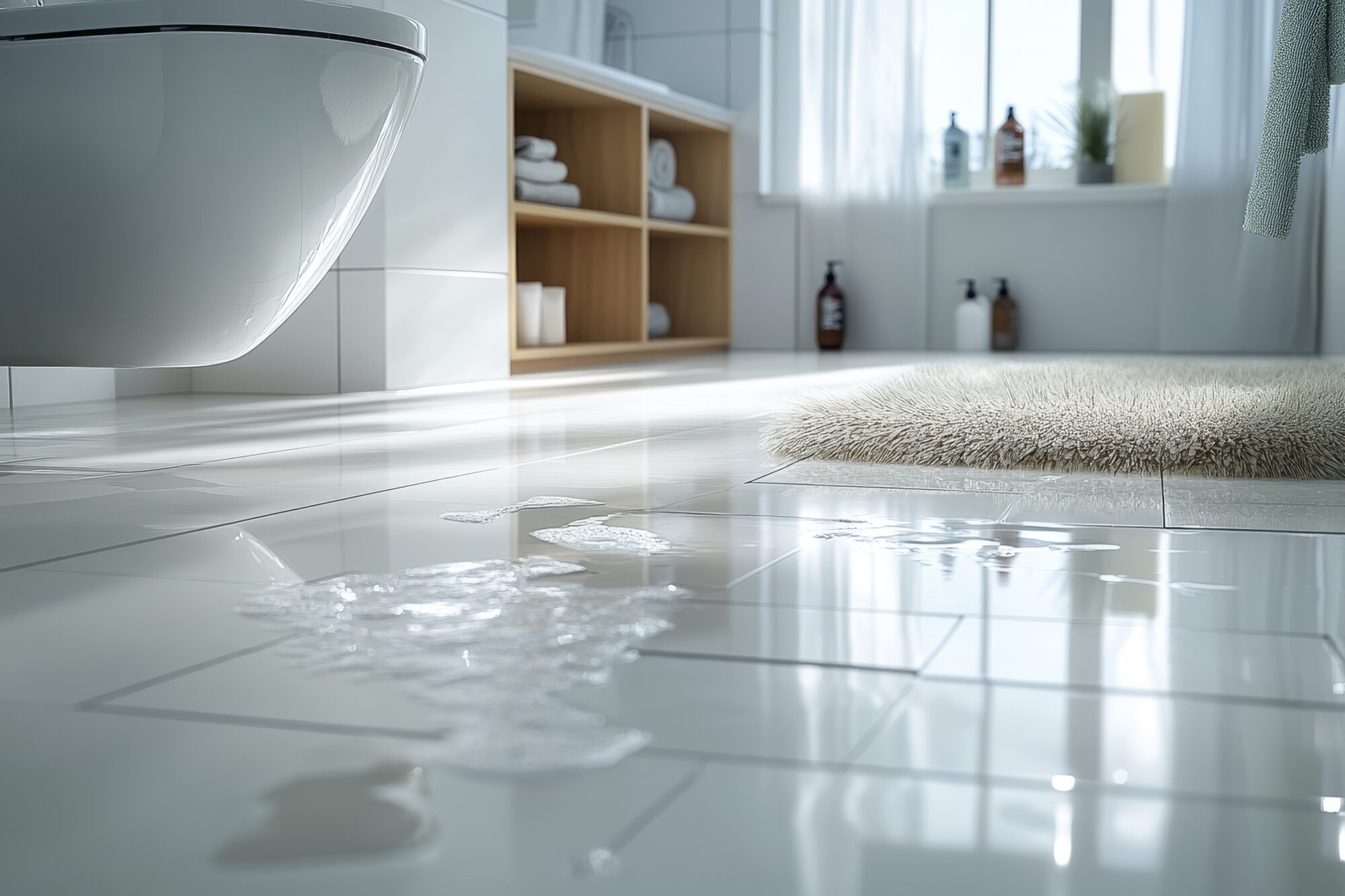
Water damage claims are among the most common and most misunderstood insurance issues in cooperative buildings. A frequent scenario goes something like this: a unit owner’s toilet supply line suddenly fails, water pours out, and before anyone can shut it down, two apartments below suffer significant damage.
The proprietary lease may clearly state that the unit owner is responsible for maintaining toilet hoses and supply lines. So, at first glance, it seems logical that the unit owner and their insurance should be responsible for all resulting damage. But in practice, insurance claims in co‑ops don’t always follow that logic, and the co‑op’s master insurance policy often ends up paying for most of the damage, even when the failed component belongs to the unit owner.
The Scenario: A Failed Toilet Supply Line
In this situation:
- A flexible supply line connected to a toilet broke inside a unit
- Water escaped rapidly, damaging:
- The unit where the failure occurred
- Two apartments below
- The proprietary lease assigned maintenance responsibility for toilet hoses and supply lines to the unit owner
Despite this lease language, the association’s insurance carrier often assumes responsibility for the water damage (up to builder’s grade) in all affected units, including the originating apartment. Why? Because under the proprietary lease, responsibility in an insurance claim situation typically hinges not on what caused the damage, but what was damaged.
Maintenance Responsibility vs. Insurance Liability
This is where many boards and managing agents get tripped up. A proprietary lease can absolutely require a unit owner to maintain certain components. However, maintenance responsibility does not automatically translate into insurance liability. For the association’s insurance carrier to successfully subrogate against the unit owner (or deny coverage outright), they generally need to establish negligence, not just ownership of the failed part. And that is often very difficult to prove.
Why Negligence Is Hard to Establish
Most toilet supply line failures are:
- Sudden
- Hidden from view
- Not preceded by visible leaks or warnings
Unless there is clear evidence that the unit owner:
- Knew the supply line was defective or leaking
- Ignored a prior leak or warning
- Installed an improper or non-code-compliant line
- Made a negligent alteration
…it is extremely challenging to prove that the unit owner acted unreasonably.
Aging, corrosion, or spontaneous failure, especially with braided hoses, typically does not meet the legal threshold for negligence. From an insurance standpoint, this makes the loss accidental rather than negligent.
Why the Co‑op’s Insurance Responds
Because negligence is hard to establish, the loss is generally treated as a covered water damage event under the co‑op’s master policy.
As a result, the association’s insurance will usually pay for:
- Water damage to common elements
- Water damage to the affected units below
- Restoration of finishes to builder’s grade, including:
- Walls and ceilings
- Subfloors
- Original flooring or finishes (if applicable)
Importantly, this often includes the unit where the hose broke, even though the failed component belonged to that unit owner. The failed supply line itself is typically excluded, but the damage caused by it is not.
What “Builder’s Grade” Really Means
Builder’s grade is a key concept in co‑op insurance claims.
In most cooperatives, the master policy covers:
- Original construction materials
- Standard finishes installed by the sponsor
- Building systems and infrastructure
Any upgrades made by a unit owner, such as custom tile, upgraded fixtures, or premium flooring, are usually not covered by the association’s policy. Those items fall under the unit owner’s HO‑6 policy. So while the co‑op’s insurance may restore the apartment, it will likely do so only to the original baseline condition.
What Happens to the Unit Owner’s Insurance?
The unit owner’s personal insurance typically steps in to cover:
- Damage to improvements and betterments
- Personal property
- Loss of use, if applicable
However, their policy is usually not responsible for the damage to other apartments unless negligence can be clearly proven. This is why subrogation efforts against unit owners in these cases often fail or are never pursued. Typically, the governing documents will also contain a waiver of subrogation preventing the association carrier from even attempting to subrogate.
A Key Difference in Condominiums
It’s also important to note that this outcome can be very different in a condominium setting. Condominium governing documents often define unit ownership more broadly than in a co‑op and may expressly state that the association is not responsible for anything installed by the unit owner, including original or replacement fixtures within the unit. In some condominiums, this language can eliminate the association’s obligation to restore damage to builder’s grade within the affected unit and, in certain cases, even shift responsibility for resulting interior damages back to the unit owner. As a result, when a similar toilet supply line failure occurs in a condominium, the insurance response is far more document‑driven, and the association’s master policy may have a much narrower scope of coverage than in a cooperative
Practical Takeaways for Boards and Managers
- Don’t assume lease language determines insurance responsibility. Insurance carriers focus on coverage triggers and not just maintenance clauses.
- Expect the master policy to respond first. In sudden water losses, this is the norm, not the exception.
- Builder’s grade is the dividing line. Make sure unit owners understand what is and is not covered by the association.
- Education reduces conflict. Many disputes arise simply because owners expect the “responsible party” to pay, rather than understanding how insurance actually works.
Water damage claims in co‑ops live at the intersection of legal documents, insurance contracts, and real-world practicality. While proprietary leases assign maintenance responsibility to unit owners, insurance outcomes are driven by coverage language and the ability or inability to prove negligence.
In cases like a failed toilet supply line, the reality is that the association’s insurance will often bear the cost of the resulting damage, even when the originating component belongs to the unit owner. Understanding this distinction can save boards, managing agents, and residents a great deal of frustration when the next inevitable leak occurs. Reach out to us with questions anytime.
